


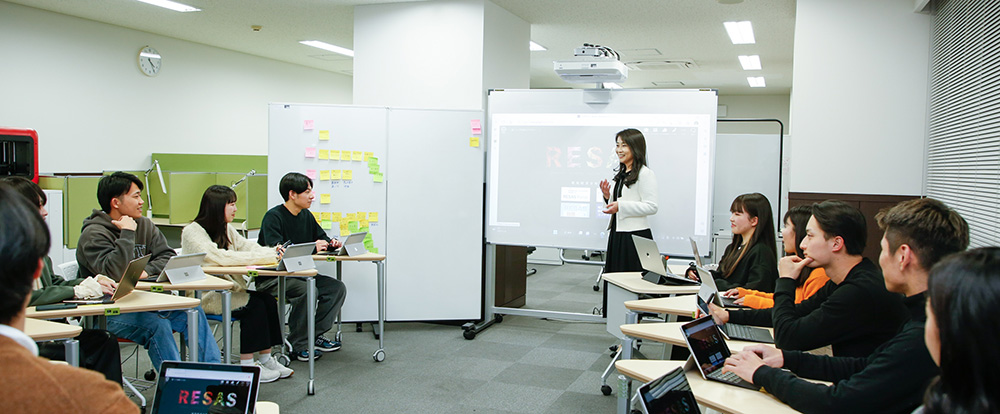
Learn Management and Marketing, Integrate Theory and Data
Reveal New Insights and Value
Reveal New Insights and Value
The core of learning in the Faculty of Business Administration Department of Data Management is made up of three parts: Management, Marketing, and Management Analysis Methods.
Our students grow into practical business professionals, having acquired the skills to analyze and judge corporate information, so it can be applied to the decision-making process for management and marketing. We also cultivate individuals who can identify issues to create value in business through zero-to-one thinking.(Created in April 2024)
Our students grow into practical business professionals, having acquired the skills to analyze and judge corporate information, so it can be applied to the decision-making process for management and marketing. We also cultivate individuals who can identify issues to create value in business through zero-to-one thinking.(Created in April 2024)
Fields of Study
The Faculty of Business Administration instills a firm understanding of the three areas of Management, Marketing, and Management Analysis Methods by teaching students the fundamentals of core subjects in their first and second years, and allowing them to comfortably move on to specialized fields of study. Our goal is to develop students into individuals who possess strong practical ability and who can make strategic decisions, as well as digital and tech-driven innovators who can leverage data and advanced IT.
Department Features
Learn Management and Marketing, Integrate Theory and Data, Reveal New Insights and Value
We aim to cultivate skills in our students necessary for future management in an advanced information-driven society. In this way, we are working to develop the type of people sought after by both private and public organizations. Utilizing the foundational strengths of the Department of Information and Management in the Faculty of Commerce, we have structured a curriculum that lets students study data science and the latest in business from a statistical point of view, in addition to traditional fields of commerce and management.
The program offers a wide range of distinctive courses that all focus on three areas, starting with Management, which nurtures the strategic intuition, knowledge, and theory central to decision-making in business. Marketing focuses on the strategic leveraging of information, and Management Analysis Methods apply data analysis and data mining to real-world problem-solving and strategy formulation. The curriculum also features practical and PBL (Project-Based Learning) courses, such as lectures by professionals in the industry, like corporate executives and marketers. These courses are where students can learn, practice, and put to use real-world value creation in business.
Learning Throughout Four Years
In the first and second years, students learn the comprehensive fundamentals of the three main areas. From the fall semester of the second year, the learning is deepened through focused study on the areas they wish to strengthen while also gaining experience in practical programs.
In addition, students will acquire the skills required in the ever-changing society of today through six courses in Business Value Creation, spanning from Introduction to Business Value Creation in the spring semester of the first year to Practical Business Value Creation II throughout the fourth year.
Distinctive Study & Classes
Active learning allows each student to take charge of their education.
The Department of Information and Management is planning to offer a variety of courses working hand-in-hand with private and public organizations. These courses use a problem-solving learning method known as PBL (Project-Based Learning), where students can acquire practical skills and critical thinking. We also offer a comprehensive and attentive support system that gives students peace of mind and allows them to develop specialized expertise in areas where they excel while receiving personalized guidance to overcome challenging parts of their studies.
Business Value Creation Integrates Theory and Practice
This specialized curriculum is broken down into six core courses related to Business Value Creation, starting with Introduction to Business Value Creation in the spring semester of the first year and running until the fourth-year-long Practical Business Value Creation II.
Through a combination of lectures and interactive workshops, students can explore what value creation really means in business and modern society, while learning the methodologies required to approach it. Thanks to our faculty’s proven track record and expertise in PBL (Project-Based Learning), we bring out the potential in professionals who can bridge the gap between theory and practice.
Qualification Acquisition
These are some of the qualifications we can help you obtain.
- Small and Medium Enterprise Management Consultant
- Fundamental Information Technology Engineer
- Information Security Management Certification
- IT Passport
- Retail Marketing (Sales Professional)
- Real Estate Transaction Specialist
- Securities Sales Representative
- Nissho Bookkeeping Examination
- Certified Administrative Procedures Legal Specialist
- The Japan Business Law Examination, and more
Aside from this, our school’s License Center also offers specialized courses to help students prepare for these credentials.
Potential Career Paths
- Business Planning / Product Development / Sales & Marketing / Human Resources / Production Management / Quality Control / IT Systems Department
- Civil Service / Graduate School
- Manufacturing, Distribution , and Retail / Finance & Insurance / Information & Communications / Real Estate / Tourism & Hospitality / Management Consulting / And More
The Creator of the QR Code Takes Office

Specially Appointed Professor Masahiro Hara
Profile
After graduating from the Department of Electrical and Electronic Engineering at Hosei University’s Faculty of Engineering, he joined Denso Corporation in 1980. After working in R&D on the development of barcode readers and other devices, he invented the QR code in 1994.
As of this writing, his major awards include the National Commendation for Invention and R&D 100 Award (USA) in 2002, Mobile Project Award Grand Prize in 2004, European Inventor Award in 2014, Japan Creation Award 2019 Grand Prize, and the Imperial Prize and Japan Academy Prize in 2023. As the Senior Chief Engineer in the AUTO-ID division of Denso Wave Inc., he continues to develop new features and advancements to the QR codes we use today.
As of this writing, his major awards include the National Commendation for Invention and R&D 100 Award (USA) in 2002, Mobile Project Award Grand Prize in 2004, European Inventor Award in 2014, Japan Creation Award 2019 Grand Prize, and the Imperial Prize and Japan Academy Prize in 2023. As the Senior Chief Engineer in the AUTO-ID division of Denso Wave Inc., he continues to develop new features and advancements to the QR codes we use today.
Don’t just develop problem-solving skills, develop problem-formulating skills.
I look forward to exploring from the perspective of data-driven management how we can utilize the QR code to build a better society together with all of you.
When I developed the QR code in 1994, my priorities were to achieve the ability to handle large amounts of information with fast and reliable reading. A QR code can store about 200 times more information than conventional bar codes and is designed to be read quickly and reliably. Because the patent was made free to use by anyone, it could spread all over the world and these days is used in all kinds of situations, such as accessing websites, making cashless payments, and downloading games.
I worked with a car parts manufacturer as an engineer in the R&D department, where I was initially in charge of developing barcode readers. Barcodes can only store information in one horizontal direction, so they can only hold a limited amount of information. I figured that in the future, there would definitely be a need for a new kind of code that stores large quantities of information and with a higher reading accuracy. It took a lot of trial and error, but in 1994, we finally succeeded in creating the QR code, which can record data in two directions, vertically and horizontally. The idea suddenly came to me while playing the board game Go with friends during lunchtime, and looking at the arrangement of black and white stones on the board.
What I want to impart to students in this faculty is the importance of developing problem-solving skills, by which I mean a proactive attitude that can identify problems on their own. Throughout the development of the QR code, I listened to the opinions of several people who use barcodes in manufacturing, logistics, and retail, so I could understand the issues with conventional barcodes. As you may know, many universities are focusing a lot on the development of problem-solving skills. However, it’s the ability to formulate problems themselves that will also become important from now on. In developing these skills, it is crucial to gather information, listen carefully to others, repeatedly ask why something is occurring, and probe deeply into the essence of the problem. I hope that through your studies with this faculty, you will foster such an ability to formulate problems.
In today’s society that is saturated with information, we gather the needed data and utilize it for business management. The study of how to accomplish this is data-driven management. In business, the collection and analysis of customer data from a range of perspectives will become increasingly important. One example involves the sharing of vast amounts of data managed by companies, local governments, and public institutions individually. Alternatively, embedding individual facial data can bypass conventional check-in procedures at companies and public facilities. QR codes are also actively used in these situations, and while sharing anecdotes from my own experience as a developer, I would like us to explore from a data management perspective ways that QR codes can be used to improve society.
I worked with a car parts manufacturer as an engineer in the R&D department, where I was initially in charge of developing barcode readers. Barcodes can only store information in one horizontal direction, so they can only hold a limited amount of information. I figured that in the future, there would definitely be a need for a new kind of code that stores large quantities of information and with a higher reading accuracy. It took a lot of trial and error, but in 1994, we finally succeeded in creating the QR code, which can record data in two directions, vertically and horizontally. The idea suddenly came to me while playing the board game Go with friends during lunchtime, and looking at the arrangement of black and white stones on the board.
What I want to impart to students in this faculty is the importance of developing problem-solving skills, by which I mean a proactive attitude that can identify problems on their own. Throughout the development of the QR code, I listened to the opinions of several people who use barcodes in manufacturing, logistics, and retail, so I could understand the issues with conventional barcodes. As you may know, many universities are focusing a lot on the development of problem-solving skills. However, it’s the ability to formulate problems themselves that will also become important from now on. In developing these skills, it is crucial to gather information, listen carefully to others, repeatedly ask why something is occurring, and probe deeply into the essence of the problem. I hope that through your studies with this faculty, you will foster such an ability to formulate problems.
In today’s society that is saturated with information, we gather the needed data and utilize it for business management. The study of how to accomplish this is data-driven management. In business, the collection and analysis of customer data from a range of perspectives will become increasingly important. One example involves the sharing of vast amounts of data managed by companies, local governments, and public institutions individually. Alternatively, embedding individual facial data can bypass conventional check-in procedures at companies and public facilities. QR codes are also actively used in these situations, and while sharing anecdotes from my own experience as a developer, I would like us to explore from a data management perspective ways that QR codes can be used to improve society.